


NIKKOR Z FX 24-70mm f/2.8 S II
Impossible de charger la disponibilité du service de retrait

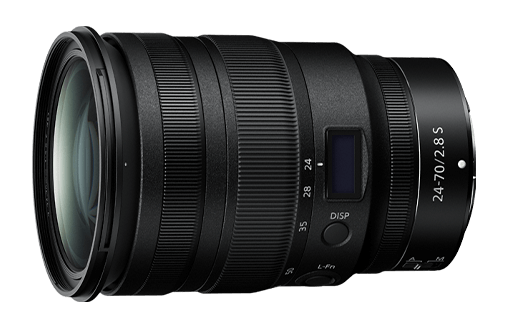
NIKKOR Z 24-70mm f/2.8 S II, the essential pro zoom lens, redefined
Faster and quieter with Nikon's best AF system to date. Smaller, lighter and more durable—all with a new optical formula that takes sharpness, bokeh and anti-glare performance to thrilling new levels.
WARNING: Do not use this product if you have a pacemaker or other medical device. The magnet or magnets in this product could cause medical devices to malfunction.
Key Features
- Full-Frame | f/2.8 to f/22
- Versatile, Fast Standard Zoom
- First Internal Zoom 24-70mm f/2.8
- 16% Lighter + Upgraded Weather-Sealing
- Silky Swift VCM Multi-Focus AF System
- Two ED and Three Aspherical Elements
- Meso Amorphous and ARNEO Coatings
- Control Ring with Click/De-Click Switch
- Dual L-Fn Buttons, Focus Limiter Switch
- Rounded 11-Blade Diaphragm
The essential pro zoom lens, redefined.
More versatile and stable with the world's first internal zoom in this class*. Faster and quieter with Nikon's best AF system to date. Smaller, lighter and more durable—all with a new optical formula that takes sharpness, bokeh and anti-glare performance to thrilling new levels.
WARNING: Do not use this product if you have a pacemaker or other medical device. The magnet or magnets in this product could cause medical devices to malfunction.
Shot with the NIKKOR Z 24-70mm f/2.8 S II
World’s first full-frame 24-70mm f/2.8 with internal zoom.

Ideal for gimbals and matte boxes.

Better protection against dust and moisture.
Nikon’s best AF system
to date.

5x faster focusing*.

50% quieter and smoother.

Enhanced tracking while zooming.
Smooth focus transitions during push-ins.
World’s lightest full-frame
24-70mm f/2.8*.
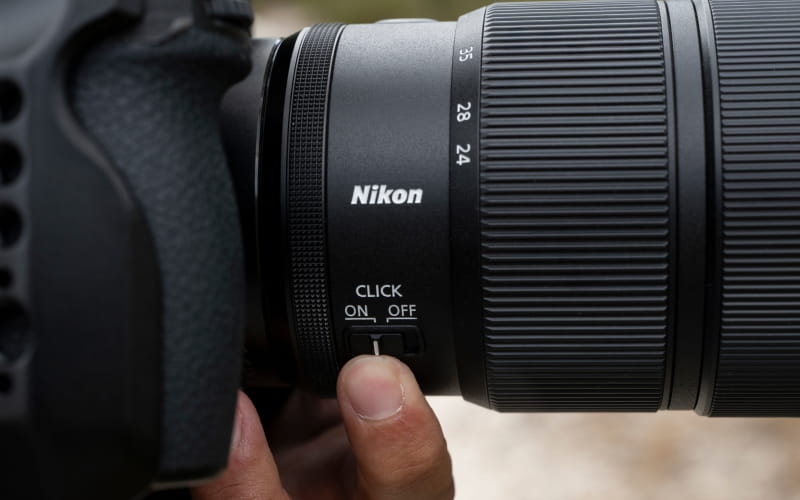
Custom control ring with
optional click.

Close focus distance.
High magnification.
Image quality that rivals prime lenses.

The superior sharpness of
a Z mount lens.

Beautiful bokeh and
natural gradation.

Clarity in all conditions.

Virtually flawless rendering.
Smart, agile handling.
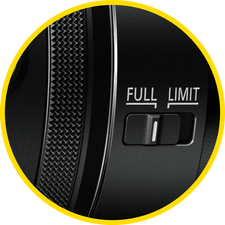
Focus Limit Switch
Activate to ignore foreground elements and enhance the speed and accuracy of focus within the desired range.
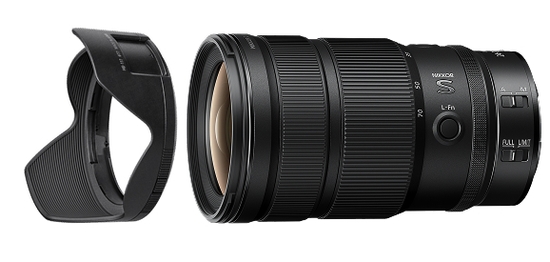
Compare to 24-70 f/2.8 S
| Lens Features |
Nikkor Z
|
Nikkor Z
|
|---|---|---|
Mount |
Z mount | Z mount |
Zoom Mechanism |
Internal Zoom | Extending Zoom |
Weight |
Approx. 675 g | Approx. 805 g |
Filter Size |
77mm | 82mm |
AF Drive System |
Silky Swift Voice Coil Motor | Stepping Motor |
AF Drive Noise |
50% Quieter than Predecessor | Near Silent |
Minimum Focus Distance |
9.4 in. | 15 in. |
Max Reproduction Ratio |
0.32x | 0.22x |
Control Ring |
Click/Clickless | Clickless |
Focus Limit Switch |
Yes | No |
Diaphragm Blades |
11 | 9 |
Anti-Reflective Performance |
Arneo Coat & Meso Amorphous Coat | Arneo Coat & Nano Crystal Coat |
Filter Access from Lens Hood |
Yes | No |
Lens Elements |
14 | 17 |
L-Fn Buttons |
2 | 1 |
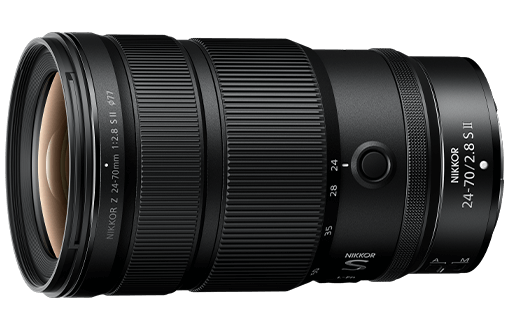
Technology
-
Silky Swift VCM
The Silky Swift VCM is utilized for NIKKOR Z lenses as an AF drive motor. This system simultaneously achieves higher speed, higher accuracy and quieter operation. Each of these factors far surpasses conventional systems, and as for the “quietness” specifically, drive sound is intensively suppressed to an almost-silent level. Even heavy lenses can be controlled accurately at high speed, with minimal noise or vibration, enabling users to reliably capture sharply focused images. Extremely quiet AF operation is specifically advantageous for shooting in places where silence is required and for video recording. WARNING: Do not use this product if you have a pacemaker or other medical device. The magnet or magnets in this product could cause medical devices to malfunction.
-
Meso Amorphous Coat
Meso Amorphous Coat* realizes the highest anti-reflection performance in NIKKOR history. Meso Amorphous Coat provides an effect superior to that of Nano Crystal Coat for diagonal incident light, and an effect equivalent or superior to ARNEO Coat for vertical incident light. With its superb performance, ghost and flare caused by incident light from various directions are noticeably reduced, delivering clear images even under harsh conditions. *With this coating system, amorphous particles, that are even smaller than nano particles, are utilized to create even more gaps within the coating to form an ultra-fine mesoporous structure, attaining a lower refractive index. In addition, a higher-precision base coat is employed to further enhance the anti-reflection effect.
-
ARNEO Coat
An anti-reflective coating developed by Nikon and used in conjunction with Nano Crystal Coat to further reduce ghost and flare effects caused by incident light entering the lens vertically. This allows for the outstandingly clear capture of images even when a light source is located within the frame.
-
Fluorine Coat
Photographers need gear that can withstand the elements. Nikon’s fluorine coat effectively repels dust, water droplets, grease or dirt, ensuring easy removal even when they adhere to the lens surface. Nikon’s fluorine coat endures a high frequency of lens surface wiping and its anti-reflective effect also contributes to the capture of clear images.
-
Internal Focus
A NIKKOR lens in which only the internal lens group shifts during focusing. These lenses will be designated with the abbreviation IF on the lens barrel.
-
ED (Extra-Low Dispersion) Glass
An optical glass developed by Nikon that is used with normal optical glass in telephoto lenses to obtain optimum correction of chromatic aberrations.
-
AS
AS stands for Aspherical lens elements. This type of lens utilizes non-spherical surfaces on either one or both sides of the glass in order to eliminate certain types of lens aberration.
-
A/M
A/M stands for Auto-Priority Manual Mode. This mode also enables an easy transition from autofocus to manual during AF operation. However, mode switch sensitivity has been altered to reduce the possibility of sudden unintentional switching to manual focus while shooting.
-
Multi Focus System
In 1967, Nikon developed the world's first focusing system that effectively suppressed aberrations by moving multiple lens groups (Close-Range Correction System). The multi-focusing system is the evolution of that AF system with which the positions of multiple focusing groups are very precisely controlled, each by its own focusing unit, all of which work together. This system effectively suppresses various types of aberration, even with scenes captured at close distances where aberrations are generally more likely to occur. This enables superior image-formation performance from maximum aperture, regardless of the focal length or shooting distance. It also contributes to faster AF. The multi-focusing system is effective even with fast lenses.
-
Electromagnetic Diaphragm Mechanism
An electromagnetic diaphragm mechanism in the lens barrel provides highly accurate electronic diaphragm or aperture blade control when using auto exposure during continuous shooting. With conventional D/G type lenses, the diaphragm blades are operated by mechanical linkage levers.
What's included?
NIKKOR Z 24-70mm f/2.8 S II
- CHB-117 Lens Hood
- CL-C2 Lens Case
- LF-N1 Rear Lens Cap
- LC-77B 77mm Snap-On Front Lens Cap
Aucune spécification disponible.


